To ensure success, each student’s learning program is tailored to his/her individual learning styles, experiences, and abilities, so specific classes taken may vary from what is listed below.
In addition, sophomores, juniors, and seniors are eligible to take online college courses that allow them the opportunity to earn college credit hours as well as high school credits. Juniors and seniors may also enroll in classes, of particular interest and not available at St. John’s, at Beloit High School and Ft. Hays Tech North Central in Beloit (when schedules align and with permission from those institutions).
Each class listed below is worth 1 credit, unless otherwise stated.
-
-
9th Grade Core Classes
Religion/Theology - Scripture: Emphasizes understanding and interpreting the Sacred Scriptures. Course objectives are designed so that students may comprehend the theological, doctrinal, and ethical messages contained within religious Scriptures.
English/Language Arts I: Builds upon students’ prior knowledge of grammar, vocabulary, word usage, and the mechanics of writing and includes the four aspects of language use: reading, writing, speaking, and listening. Introduces and defines various genres of age-appropriate literature - between novels, biographies, and short stories - with writing exercises linked to reading selections and the Institute for Excellence in Writing (IEW) curriculum, which focuses on a systematic, step-by-step approach to teaching writing, balancing structure (organization) and style (stylistic techniques) for students.
Mathematics: Course taken is dependent on individual student skill level - see Mathematics section below.
Integrated Science: Includes the principles of several scientific specialties – earth science, physical science, biology, chemistry, and physics – and organizes the material around thematic units. Themes covered include systems, models, energy, patterns, change, and constancy.
Social Sciences - Contemporary World Issues: Political, economic, and social issues facing the world in the 20th Century are studied. There is an emphasis on current issues and selected issues throughout the 20th Century to examine historical causes and possible solutions. Selected topics include the post-WWII era, Civil Rights Movement, Vietnam War, and Counterculture movement of the 60's and 70's.
Computer Applications: Students work with a wide range of digital media applications including word processing, presentation, spreadsheet, database, e-mail, desktop publishing, image manipulation/graphics, and Internet used as a research tool. Students focus upon the proper legal and ethical uses of digital media applications.
Physical Education (1/2 credit): Provides students with knowledge, experience, and an opportunity to develop skills in a variety of sports or activities including team sports, individual/dual sports, recreational sports, and fitness/conditioning activities.
Health (1/2 credit): A variety of health education topics are presented including nutrition, mental health and stress management, drug/alcohol abuse prevention, disease prevention, first aid, and consumer health issues.
-
10th Grade Core Classes
Religion/Theology - Religious Ethics & Morality: Provides an introduction to the tenets of faith, religious ethics, and morality and enables students to apply the moral teachings of faith to their own lives, to the larger community, and to their decision-making processes. Course content focuses on issues such as peace and justice, death and dying, human sexuality, professional ethics, and human rights.
English/Language Arts II: Students write persuasive, critical, and creative multi-paragraph essays and compositions. Through the study of various genres of literature - particularly British Literature - students can improve their reading rate and comprehension and develop the skills to determine the author’s intent and theme and recognize the techniques used by the author to deliver his or her message. Students continue to advance in the Institute for Excellence in Writing (IEW) curriculum, which focuses on a systematic, step-by-step approach to teaching writing, balancing structure (organization) and style (stylistic techniques) for students.
Mathematics: Course taken is dependent on individual student skill level - see Mathematics section below.
Biology: Provides information regarding the fundamental concepts of life and life processes. Includes topics such as cell structure and function, general plant and animal physiology, genetics, and taxonomy.
World History - Overview: World History provides an overview of the history of human society studying the key topics of Rise and Fall of Rome, Feudalism, Middle Ages, Renaissance and Reformation, Age of Absolutism, Scientific Revolution, and the French Revolution. This overview examines political, economic, social, religious, military, scientific, and cultural developments of the time.
Spanish I: Designed to introduce students to Spanish language and culture. Emphasizes basic grammar and syntax, especially regarding verb conjugations in a variety of tenses, simple vocabulary, and the spoken accent so that students can read, write, speak, and understand the language at a basic level within predictable areas of need, using customary courtesies and conventions.
-
11th Grade Core Classes
Religion/Theology - Catholic Apologetics: Learn how to understand and defend the Catholic Christian faith. Topics include: St. Thomas Aquinas’ 5 proofs of God’s Existence, Can you prove the Resurrection?, Divinity of Jesus?, The existence of objective truth?, and many other faith and moral positions.
English/Language Arts III: Students continue to develop writing skills, emphasizing clear, logical writing patterns, word choice, and usage, as students write essays and continue to learn the techniques of writing research papers, including in-text citations in the MLA format. Students continue to read works of literature - studying American Literature from the discovery of America to the present day. Students continue to advance in the Institute for Excellence in Writing (IEW) curriculum, which focuses on a systematic, step-by-step approach to teaching writing, balancing structure (organization) and style (stylistic techniques) for students.
Mathematics: Course taken is dependent on individual student skill level - see Mathematics section below.
Chemistry: Study the composition, properties, and reactions of substances. Explore concepts such as the behaviors of solids, liquids, and gases; acid/base and oxidation/reduction reactions; and atomic structure. Chemical formulas and equations and nuclear reactions are also studied.
US History - Comprehensive: This course provides an overview of the history of the United States, including political, military, scientific, and social developments of the Age of Industrialization through World War II.
Consumer Economics/Personal Finance: Students gain an understanding of universal economic concepts and terminology, then narrow down to focus upon principles involved in managing one’s personal finances. Topics include spending patterns and budgeting, banking and credit, saving and investing, insurance, taxes, contracts, and consumer protection.
-
12th Grade Core Classes
Religion/Theology - Theology of the Body/Dating, Marriage and Family Life Studies: Study the biblical order of dating, marriage, and family life through the lens of St. John Paul II’s Theology of the Body. Topics include the biblical definition of love and what that looks like through various vocations, with special emphasis placed on the four qualities of love in the Catholic wedding vows; free, total, faithful, and fruitful.
English/Language Arts IV: Blends composition and literature into a cohesive whole as students write critical and comparative analyses of selected literature, learn college-level MLA and APA standards, and then write academic research papers as they continue to develop high-level language arts skills. This course is cross-listed as English Composition I & II and is available for college credit.
Mathematics: Course taken is dependent on individual student skill level - see Mathematics section below.
Chemistry: Study the composition, properties, and reactions of substances. Explore concepts such as the behaviors of solids, liquids, and gases; acid/base and oxidation/reduction reactions; and atomic structure. Chemical formulas and equations and nuclear reactions are also studied.
OR
Physics: Course topics include motion and forces; force pairs and momentum; gravitation; electrostatics; energy; electromagnetics; electromagnetic radiation; nuclear physics; kinematics; force and translational dynamics; work, energy, and power; linear momentum; torque and rotational dynamics; energy and momentum of rotating systems; oscillations; and fluids.
OR
Environmental Science and Sports Physiology: In Environmental science students will cover Kansas native plants and animals, compete in the State Eco-meet and Envirothon competitions, and discuss environmental policy, impacts, and concepts. Students will also be introduced to First Aid/CPR/AED, human systems, and competitive sports.US Government - Comprehensive: US Government provides an overview of the structure and functions of the US government including the three branches of government and their respective political institutions. Constitutional principles, the concepts of rights and responsibilities, the role of political parties and interest groups, and the importance of civic participation in the democratic process are examined in the course.
Digital Media Technology/Career Exploration:
Digital Media Technology: An introductory college-level computer course designed for individuals to become familiar with computers and their operations. An integrated software program will be used to apply this knowledge in word processing, database, digital presentation and electronic spreadsheet technology for both home and business use. Students may choose to take the course for concurrent college credit.
Career Exploration: Students identify and evaluate personal goals, priorities, aptitudes, and interests to make informed decisions about their future careers and complete activities that are designed to develop job search and employability skills. During the spring semester, students leave school for weekly 1.5-hour job shadowing sessions, observing people working in career areas of interest to them and learning directly from those individuals. Class time is also made available to work on scholarship forms, essays and related materials. -
Mathematics
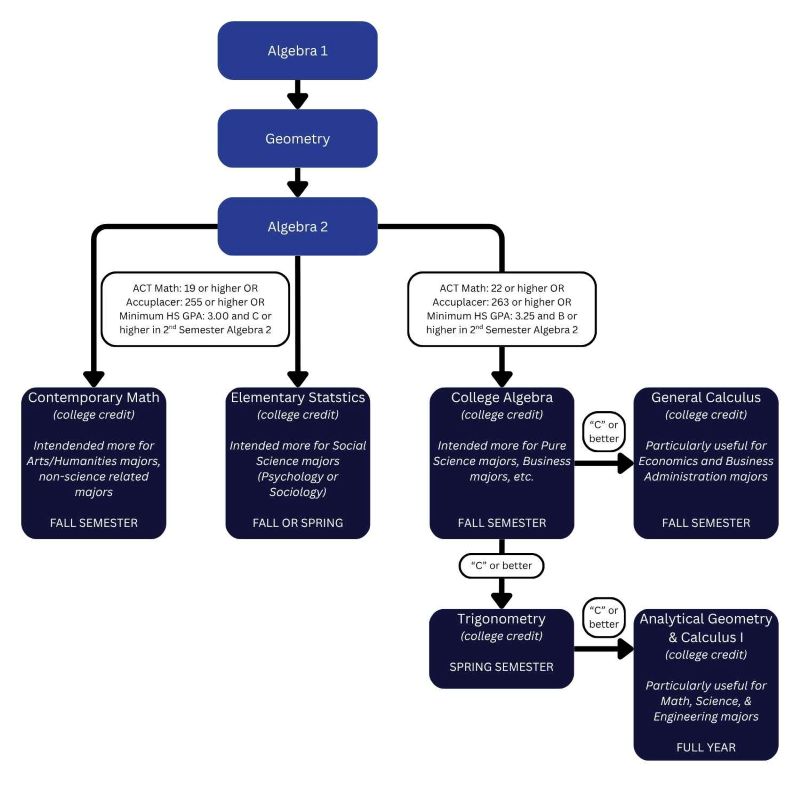
**Course taken in each grade level is dependent on individual student skill level - see flowchart below.**
Algebra I: The study of properties and operations of the real number system; evaluating rational algebraic expressions; solving and graphing first degree equations and inequalities; translating word problems into equations; operations with and factoring of polynomials; and solving simple quadratic equations. (Note: This course is also available in a slower pace format of Parts I and II in separate courses).
Geometry: Emphasizes an abstract, formal approach to the study of geometry including topics such as properties of plane and solid figures; deductive methods of reasoning and use of logic; geometry as an axiomatic system including the study of postulates, theorems, and formal proofs; concepts of congruence, similarity, parallelism, perpendicularity, and proportion; and rules of angle measurement in triangles.
Algebra II: Course topics typically include field properties and theorems; set theory; operations with rational and irrational expressions; factoring of rational expressions; in-depth study of linear equations and inequalities; quadratic equations; solving systems of linear and quadratic equations; graphing of constant, linear, and quadratic equations; properties of higher degree equations; and operations with rational and irrational exponents.
Contemporary Math (3 hrs. college credit): Explores the uses of mathematics in different settings. Applications are seen in the contemporary world, across different disciplines. Topics will include, but are not limited to, the following: critical and logical thinking, statistics and probability, the application of mathematics to social issues such as voting, and financial applications.
Elementary Statistics (3 hrs. college credit): This course is designed for students with adequate algebra background to cover introductory, non-calculus-based statistics. Topics covered include sampling and displaying data, measures of central tendency and variation, introductory probability theory, discrete probability distributions (binomial), normal distributions, standard normal distributions, sampling distributions and the central limit theorem, estimating parameters, hypothesis testing, regression and correlation, chi-square, and non-parametric statistics.
College Algebra (3 hrs. college credit): This course reviews standard topics of algebra. Students will study linear and quadratic equations; functional notation; linear, quadratic, rational, logarithmic and exponential functions; systems of equations and inequalities; and matrix algebra. Other topics may be covered at the instructor’s discretion.
Trigonometry (3 hrs. college credit): This course is a study of trigonometric functions and their applications, solutions to right and oblique triangles, trigonometric identities, inverse functions, graphs of trigonometric functions, and vectors.
General Calculus (3 hrs. college credit): This course is an introduction to calculus particularly useful to economics and business administration students. It requires little knowledge of trigonometry, and is not intended for a student seeking a degree in a science-related field. Topics covered include limits, derivatives, multivariate calculus, and basic integrals. Practical applications include optimization, analysis of graphs for sales and marketing purposes, and marginal analysis.
Analytical Geometry & Calculus I (5 hrs. college credit): This course reviews inequalities, linear equations, function notation, graphing and trigonometry. Students will study limits, continuity, derivatives, differentials, L'Hopital's Rule, and integrals. Practical applications include graphing, motion, optimization, related rates, Newton’s Method, L’Hopital’s Rule, and area.
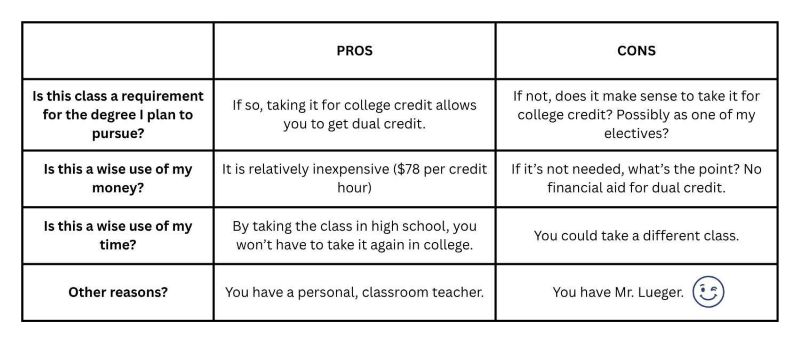
Should I take my math class for college credit or not?
-
Elective Classes
**Note: Electives that are offered each year can vary.
Vocal Ensembles (0.5 credit): Students develop healthy singing habits to include proper diction, breath support, and stylistic differences across many genres of music. Finally, the students develop a deeper understanding of liturgical music and its role in the Mass throughout the liturgical year.
General Band (0.5 credit): Develops students’ technique for playing brass, woodwind, and percussion instruments and covers a variety of non-specified band literature styles (concert, marching, orchestral, and modern styles).
Publication Production (Yearbook) (0.5 or 1 credit): Students in this course will perform all necessary steps in writing, editing, publishing and distributing the school yearbook. This course integrates in-person advertising sales within the region, language arts, photography and technology. The advisor will coach students in the areas of good subject matter, photography, caption writing, editing and journalistic ethics, and rely upon veteran staff to help lead first-year students in creating clear processes that result in a quality product. Fairness, accuracy, teamwork and the ability to meet deadlines are the foundation upon which students will operate in this class.
Digital Media Design & Production (In-House Training) (11th and 12th Grade): This is an entirely “hands-on” course. Students will use digital devices, time management and planning skills developed in earlier classes to do project work for the school and community. Students will work independently to produce items such as programs for games, concerts, graduation, homecoming and other events, along with other projects that rely upon the student’s expertise and abilities. Enrollment is typically capped at 2-3 students per semester.
Entrepreneurship (11th Grade): Acquaints students with the knowledge and skills necessary to own and operate their own businesses. Topics include economics, marketing principles, human relations and psychology, business and labor law, legal rights and responsibilities of ownership, business and financial planning, finance and accounting, and communication. Emphasis placed on communicating with professionals and the creation of a capstone project - a business plan - that is presented at a county-wide competition.
Spanish II (11th and 12th Grade): Spanish II emphasizes grammar development and vocabulary-building to increase competency in spoken and written language skills as well as reading. Spanish II is the natural development of the basic skills learned in the prerequisite Spanish I class. Students also have the opportunity to share basic Spanish knowledge with elementary classes, building their own language skills as they teach others.
Religion Elective (0.5 or 1 credit): Specific topics covered vary from year to year.
Strength & Conditioning (10th-12th Grade): Strength and Conditioning is an elective physical education course designed to instruct students in proper lifting techniques, strength training principles, and safety protocols to enhance muscular strength, endurance, and overall fitness.
Online Course Opportunities (10th-12th Grade):
During open elective course periods, students may choose to take online courses in areas of interest as part of the student’s Individual Plan of Study. Options currently include high school-only credit provided through the Smoky Valley Virtual Charter School or concurrent high school/college courses taught primarily by Cloud County Community College and Ft. Hays Tech North Central. However, students may choose to take college course work for concurrent high school credit from other post-secondary schools with administrator permission.
It must be noted that St. John’s staff members who proctor online course options have discretion to modify course content, assignment re-takes and grades ONLY for the Smoky Valley Virtual Charter School courses. St. John’s has NO ability to modify course content, re-takes or grading for any college credit course; all letter grades and percentages reported by college instructors to St. John’s are placed directly on the student’s transcript.
As per the school handbook, all high school-only courses are graded using the regular high school grading scale, while courses taken for concurrent high school and college credit are graded using the college course grading scale.
-
In Person Concurrent-Credit Courses
The courses: English Composition I, English Composition II, College Computer Applications, Contemporary Math, Elementary Statistics, College Algebra, General Calculus, Trigonometry, and Analytical Geometry & Calculus I are taught during the school day by St. John’s staff, and may be taken for concurrent high school and college credit through Cloud County Community College if students meet the necessary minimum requirements of CCCC and pay all appropriate fees to earn the college credit.
- 1